
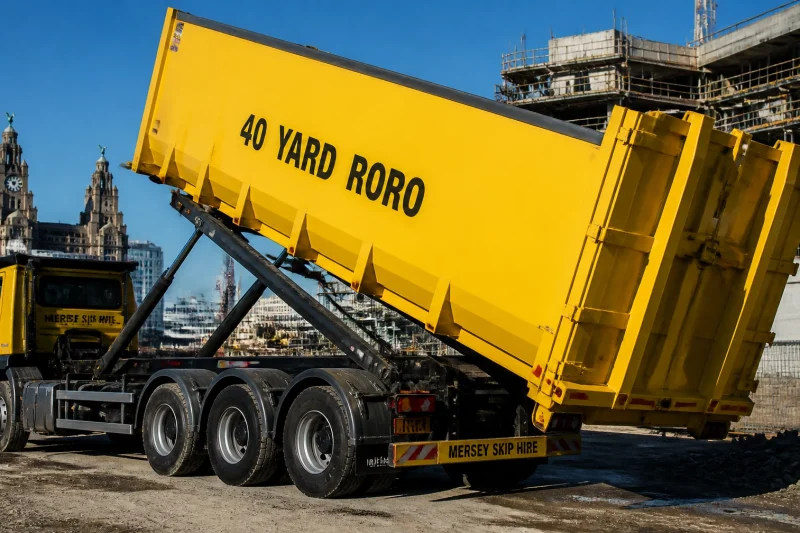
Roll-on roll-off (RoRo) skips provide the highest capacity for waste management on large-scale projects. We supply these containers for commercial developments, shop refits, and demolition sites across Liverpool and the North West. Standard skips reach capacity quickly on high-output sites. RoRo containers offer a more efficient solution for bulk waste removal.
Technical Specifications: 20-Yard vs 40-Yard Containers
We provide two primary sizes of RoRo skips. Both share a similar footprint but differ in height and payload capacity.
20-Yard RoRo Container
- Length: 6.1 metres (20 ft)
- Width: 2.4 metres (8 ft)
- Height: 1.2 – 1.6 metres (4 – 5 ft)
- Capacity: Approximately 160 – 220 bin bags
- Primary Use: Heavy inert waste including soil, concrete, and hardcore
40-Yard RoRo Container
- Length: 6.1 metres (20 ft)
- Width: 2.4 metres (8 ft)
- Height: 2.4 – 2.7 metres (8 – 9 ft)
- Capacity: Approximately 350 – 440 bin bags
- Primary Use: Bulky, low-density waste including timber, plastics, and general mixed construction debris
Choosing between these sizes depends on waste density. We've found that 20-yard containers are necessary for heavy materials to stay within road weight limits. 40-yard containers are optimal for maximizing volume when handling lighter materials. For more details on standard skip alternatives, view our guide to choosing the right skip size.

Site Requirements and Access Logistics
RoRo skips require significant space for delivery and positioning. We use hook-lift vehicles to deposit and retrieve these containers.
Access Criteria
- Entrance Width: Minimum 3.5 metres clearance for the vehicle.
- Ground Surface: Reinforced concrete or hardstanding. Asphalt may suffer damage under full loads.
- Overhead Clearance: No low cables, branches, or building overhangs. The hook-lift arm requires 7 metres of vertical clearance during operation.
- Turning Circle: Large radius required for 32-tonne hook-lift vehicles.
Positioning Protocols
- Loading Access: Rear doors must have clearance to swing open 270 degrees.
- Permits: RoRo skips cannot be placed on public highways. They must reside on private land or within a secure site perimeter.
- Safety: We require 2 metres of clear space around the container for safe loading operations.
We recommend checking site access before booking. For projects where access is restricted, grab wagon hire may be a more viable alternative.
Financial Efficiency for Commercial Contractors
RoRo containers reduce the total number of vehicle movements on site. This leads to direct cost savings for commercial projects.
Reduced Haulage Costs
Fewer collections mean lower transportation fees. One 40-yard RoRo carries the equivalent of five 8-yard builder's skips. We've seen contractors reduce waste management overheads by 20-30% through RoRo deployment.
Improved Site Productivity
Fewer vehicle movements result in less site disruption. Labourers spend less time managing skip exchanges. Site entrances remain clear for materials deliveries. This is critical for demolition projects in Liverpool where timelines are tight.
Waste Compaction
40-yard containers are compatible with portable waste compactors. This further increases the volume of waste removed per haul. It is the most cost-effective method for high-volume, low-density waste streams.

Waste Stream Management and Recycling
We operate a 100% recycling policy. All waste collected in our RoRo containers is processed at our regional facility.
Permitted Materials
- Wood/Timber: Pallets, joists, and offcuts.
- Metal: Ferrous and non-ferrous scrap.
- Plastics: Packaging, piping, and cladding.
- Inert Waste: Bricks, concrete, and soil (20-yard only).
- General Mixed Waste: Plasterboard, cardboard, and textiles.
Prohibited Items
RoRo containers are not suitable for hazardous materials. We do not accept:
- Asbestos
- Chemicals or solvents
- Gas cylinders
- Tyres
- WEEE waste (Electrical items)
For mixed loads, we provide detailed waste transfer notes. This documentation is required for BREEAM and LEED certification on modern construction sites. We track all waste to ensure zero landfill contribution.
BSM Operational Standards and Delivery
We maintain a fleet of modern, eco-friendly vehicles. Our drivers are experienced in navigating complex construction sites across the North West.
Service Deliverables
- Same-Day Booking: We offer rapid response for urgent site clearances.
- Scheduled Exchanges: We coordinate swap-outs to ensure continuous waste disposal capacity.
- Transparent Pricing: No hidden fees for weight overages within agreed limits.
- Driver Standards: Fully trained and insured operators for every delivery.
We've carried out RoRo placements for retail refits in Liverpool city centre and large-scale industrial clearances in Bootle. Our fleet is equipped with the latest telematics for accurate delivery windows.

Summary Table: Skip vs RoRo Comparison
| Feature | 8-Yard Builder's Skip | 20-Yard RoRo | 40-Yard RoRo |
|---|---|---|---|
| Capacity | 8 cubic yards | 20 cubic yards | 40 cubic yards |
| Bags | ~60-80 | ~160-220 | ~350-440 |
| Weight Limit | 8 Tonnes | 10+ Tonnes | 10+ Tonnes |
| Loading | Top load | Walk-in/Plant | Walk-in/Plant |
| Footprint | 3.7m x 1.8m | 6.1m x 2.4m | 6.1m x 2.4m |
| Permits | Road permits available | On-site only | On-site only |
For smaller projects or residential renovations, an 8-tonne skip is usually sufficient. For everything else, RoRo containers provide the industrial-scale support required.
We provide full groundworks and demolition support alongside our waste management services. This integrated approach simplifies project logistics for our commercial clients. We've done the heavy lifting for years. We'll do it for your next project too.